

The Definitive Guide to Broadleaf Weed Control and Turf Excellence
As the spring season hits its stride across the tri-state area, homeowners in Maryland, Pennsylvania, and West Virginia are facing a common foe: the rapid emergence of broadleaf weeds. While the sight of a yellow dandelion or a purple patch of henbit might seem like a minor nuisance, these invaders are the first sign of a larger battle for the health and beauty of your turf. At Grosh’s Lawn Service, we have spent 36 sensational years perfecting the art of the “green” lawn, and today we are sharing the sensational secrets that separate a professional result from a struggling yard.
To understand the necessity of broadleaf weed control, one must first understand the biology of the invaders. Unlike crabgrass, which is a grassy weed, broadleaf weeds are dicots. This means they emerge with two seed leaves and typically have broad, flat leaves with a branching vein pattern. Because their physiology is different from your lawn’s grass, specialized broadleaf weed control is required to eliminate the weed without harming the surrounding turf.
1. The Power of Proper Identification
The first secret to successful broadleaf weed control is knowing exactly what is growing in your soil. Identification is the foundation of any professional program. In our region, encompassing Clear Spring, MD, and reaching into PA and WV, the most common spring offenders include:
- Dandelions (Taraxacum): These are the most famous targets of broadleaf weed control, known for their deep taproots. For more information on the biology of these perennials, you can visit the University of Maryland Extension website.
- Henbit and Purple Deadnettle: These winter annuals create a purple haze across lawns in April. Effective broadleaf weed control must target these before they drop seeds and die back, leaving bare spots for summer weeds.
- Common Chickweed: A low-growing, succulent weed that thrives in moist, shaded areas. It requires specific broadleaf weed control surfactants to penetrate its waxy leaves.
- Hairy Bittercress: A small weed that launches seeds several feet when touched, making it a prolific spreader that demands early broadleaf weed control intervention.

2. Timing is the Professional’s Edge
In the world of professional lawn care, timing isn’t just a factor—it is everything. Applying broadleaf weed control too early or too late can lead to wasted product and resilient weeds. The sensational secret is to apply post-emergent treatments when the weeds are actively growing but before they have reached full maturity or dropped their seeds.
In Maryland and the surrounding WV and PA counties, mid-April is the “Goldilocks” window where soil temperatures and plant growth align for a total kill. When you utilize professional broadleaf weed control during this window, you catch the plant while its vascular system is moving nutrients rapidly, allowing the treatment to reach the root faster.

3. The Superiority of Liquid Professional-Grade Treatments
Many homeowners reach for “weed and feed” bags at the local big-box store. However, the secret to a truly weed-free lawn lies in professional-grade liquid broadleaf weed control applications. Liquid treatments provide superior coverage of the leaf surface. Our specialized mixtures are designed to stick to the leaf and travel down to the root system, ensuring the weed doesn’t just turn brown—it disappears for good. This is a hallmark of professional lawn care that residential products simply cannot match.
4. Mowing Height: Your Natural Weed Barrier
One of the most overlooked secrets to broadleaf weed control is your mower setting. Many people believe that cutting the grass short makes it look “cleaner,” but it actually invites weeds to move in. By keeping your cool-season grass (like tall fescue) at a height of 3.5 to 4 inches, you create a dense canopy. For detailed mowing guidelines, the Penn State Extension provides excellent research on turf height and weed suppression.
5. Cultivating Healthy Soil for Natural Defense
A sensational lawn is built from the ground up. Weeds are opportunistic; they look for thin, stressed, or poorly fed turf. By maintaining a consistent fertilization schedule and ensuring your soil pH is balanced, you empower your grass to win the competition for nutrients and space. When your lawn is thick and healthy, there is simply no room for a dandelion to take root, reducing the need for heavy broadleaf weed control in the future. Professional lawn care is as much about growing good grass as it is about killing bad weeds.
6. Consistency Across State Lines
Whether you are in Clear Spring, MD, Berkeley County, WV, or Franklin County, PA, the climate challenges are similar, but the local soil conditions can vary. Professional broadleaf weed control is not a one-time event; it is a seasonal partnership. By staying ahead of the growth cycles and monitoring the lawn throughout the spring and summer, we ensure that your property remains a source of pride.
Why DIY Broadleaf Weed Control Often Fails
Many property owners attempt their own broadleaf weed control only to find the dandelions returning weeks later. This usually happens because:
- Incorrect Herbicide Choice: Not all broadleaf weed control products target all species.
- Weather Interference: Rainfall shortly after application can wash away DIY products.
- Calibration Issues: Applying too little results in no kill, while too much can damage your grass.
By choosing professional lawn care, you ensure the right product is used at the right rate, every time.
The Long-Term Value of Professional Lawn Care
Investing in broadleaf weed control today saves money on costly lawn renovations tomorrow. When weeds are allowed to take over, they choke out the grass, leading to erosion and thinning. Our comprehensive professional lawn care approach ensures your soil remains productive and your curb appeal remains high.
The Ultimate Regional Lawn Care & Broadleaf Weed Control Calendar
A truly sensational lawn isn’t made in a single afternoon; it is the result of a dedicated, year-round strategy. Because our tri-state region experiences distinct seasonal shifts, your Broadleaf Weed Control and fertilization efforts must adapt to the weather, soil temperature, and growth cycles of cool-season grasses like Tall Fescue and Kentucky Bluegrass.
January: Planning and Equipment Prep
While the ground is often frozen in Clear Spring, MD, and surrounding areas, January is the time for strategy.
- The Secret: Review your lawn’s performance from the previous year. Were there areas where dandelions were particularly stubborn?
- Action: Professional lawn care providers like Grosh’s Lawn Service are already planning the routes and logistics for the spring Broadleaf Weed Control surge. This is the best time to lock in your service contract to ensure you are on the schedule for the critical spring window.
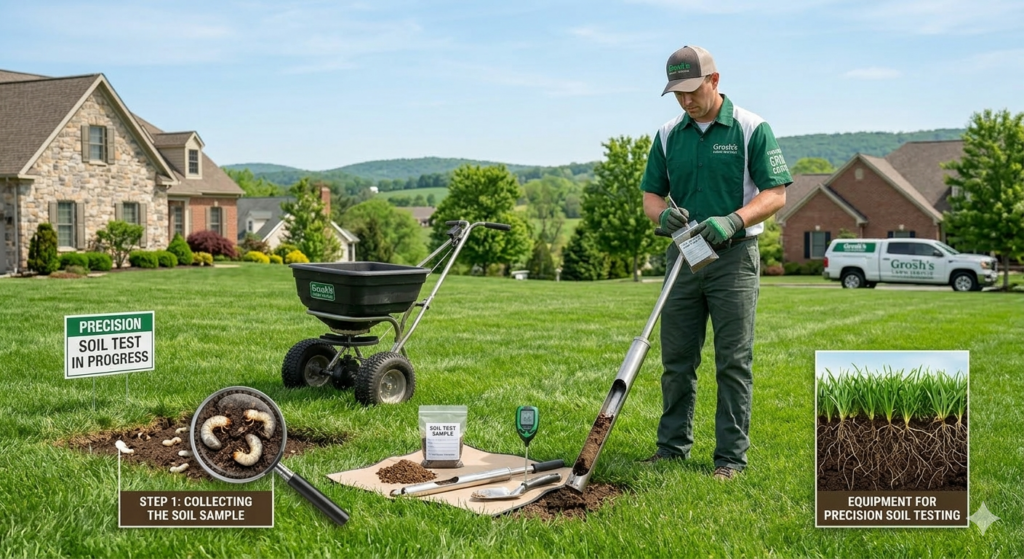
February: Soil Testing and Dormant Care
As the winter begins to lose its grip, we focus on the foundation of the lawn: the soil.
- The Secret: Soil pH is the “silent killer” of a green lawn. If your soil is too acidic, your grass cannot absorb nutrients, making it weak and susceptible to invaders.
- Action: Perform soil testing. If the pH is off, applying lime now allows it to work into the soil before the spring growth begins. A balanced soil pH makes future Broadleaf Weed Control treatments significantly more effective.
March: The Awakening and Pre-Emergent Application
March is when the first signs of life appear.
- The Secret: While everyone focuses on dandelions, we are also looking for grassy weed prevention.
- Action: This is the window for pre-emergent applications to stop crabgrass. However, it is also when winter annuals like henbit and chickweed start to bloom. Early-season Broadleaf Weed Control can be applied on warmer days to stop these purple and white “blankets” from taking over your yard.
April: The Prime Broadleaf Weed Control Window
This is the most critical month for a sensational lawn.
- The Secret: April is the “Goldilocks” month for Broadleaf Weed Control. The soil is moist, the air is warming up, and broadleaf weeds are growing rapidly.
- Action: Apply professional-grade liquid Broadleaf Weed Control. Because the weeds are actively moving nutrients from their leaves to their roots, they will pull the herbicide deep into the taproot, ensuring a total kill. This prevents dandelions from turning into white puffballs and spreading thousands of seeds across your neighborhood.
May: Strengthening the Turf Canopy
As we move into late spring, the focus shifts from killing weeds to strengthening the grass.
- The Secret: A thick lawn is its own best defense.
- Action: Apply a slow-release fertilizer to provide a steady “diet” for your grass. We continue to monitor for any late-emerging broadleaf varieties, applying spot Broadleaf Weed Control as needed to keep the turf pristine as we head into the heat of summer.
June: Summer Protection and Mowing Height
The Maryland heat can be brutal on cool-season turf.
- The Secret: The 4-inch rule.
- Action: Raise your mower height to at least 3.5 to 4 inches. This taller grass shades the soil, which keeps the roots cool and prevents new weed seeds from germinating. Taller grass reduces the need for emergency Broadleaf Weed Control during the stressful summer months.
July: Drought Management and Scouting
During the hot, dry spells of July, your lawn may go into a semi-dormant state.
- The Secret: Avoid heavy treatments during extreme heat.
- Action: We transition to “scouting” mode. We look for tough summer weeds like Clover and Oxalis. These require specialized Broadleaf Weed Control surfactants that won’t stress the grass during high temperatures.
August: Planning for the Fall Renovation
August is the month of preparation for the most important “growing” season of the year.
- The Secret: Fall is actually the best time for turf growth in our region.
- Action: Start planning for core aeration and overseeding. By thinning out any remaining broadleaf weeds now with targeted Broadleaf Weed Control, you create clean “real estate” for new grass seed to take root in September.
September: Aeration, Seeding, and Feeding
This is the “New Year” for your lawn.
- The Secret: New seed needs space and nutrients.
- Action: Core aeration is performed to break up the Maryland clay soil. We apply starter fertilizer and high-quality seed. Note: We pause heavy Broadleaf Weed Control during this time to allow the new, “baby” grass to grow without interference.

October: Fall Broadleaf Weed Control Surge
While most people think weed control is just for spring, fall is equally important.
- The Secret: Perennial weeds are moving nutrients to their roots for winter storage.
- Action: Apply a fall round of Broadleaf Weed Control. Just like in April, the weeds will pull the treatment deep into the roots, ensuring they don’t survive the winter to haunt you next spring. This is the “secret weapon” for a weed-free yard in March.
November: Winterizer and Final Cleanups
As the leaves fall, the lawn needs one last boost.
- The Secret: Root growth happens even when the blades stop growing.
- Action: Apply a heavy nitrogen “winterizer” fertilizer. This encourages deep root development over the winter. A strong root system means a faster “green-up” in the spring and a lawn that is strong enough to resist broadleaf invaders naturally.
December: Dormancy and Protection
The lawn goes to sleep, but our work continues behind the scenes.
- The Secret: Keep the lawn clear of debris.
- Action: Ensure leaves and branches are removed so they don’t “smother” the grass. Smothered grass creates bare spots—and bare spots are exactly where broadleaf weeds will try to grow as soon as the snow melts.
Why Regional Expertise Matters for Broadleaf Weed Control
Living in the tri-state area means dealing with a variety of micro-climates. A lawn in the mountains of Pennsylvania may have a different growth cycle than a lawn in the valleys of West Virginia or the rolling hills of Clear Spring, Maryland.
At Grosh’s Lawn Service, our 36 years of experience means we know the local soil types and the exact timing required for effective Broadleaf Weed Control. We don’t use a “one size fits all” approach; we tailor our applications to the specific needs of your property and the current weather patterns of our region.
Contact Karen and Tom Grosh today at https://www.groshslawnservice.com/contact-us/ to schedule your lawn care services.

Visit our website at https://www.groshslawnservice.com/
#LawnCare #WeedControl #Maryland #WestVirginia #Pennsylvania #Dandelions #SpringLawnCare #GroshsLawnService #ClearSpringMD #GreenLawn
An official production of Grosh’s Lawn Service. All rights reserved.