

Maintaining a thick, resilient, and healthy lawn in the unique climate of the Mid-Atlantic and tri-state area requires more than just occasional mowing. 🚜 Residents in Maryland, Pennsylvania, and West Virginia face a specific set of environmental challenges—from clay-heavy soils and humid summers to fluctuating winter temperatures that can stress even the hardiest turf. ❄️ To achieve a truly “green” lawn that lasts throughout the seasons, a structured approach to Lawn Care Treatment Service is non-negotiable. Tri-State Area Lawn Care by Grosh’s Lawn Service.
Whether you are battling aggressive crabgrass in Clear Spring, dealing with soil compaction in Southern Pennsylvania, or trying to prevent brown patch during a humid West Virginia July, understanding the science behind your soil is the first step toward success. 🧪 This comprehensive guide explores the seven most critical Lawn Care Treatments for tri-state lawns, ensuring your outdoor space remains the pride of the neighborhood. 🏡
Understanding the Tri-State Climate and Soil Chemistry 🔬
Before diving into specific Lawn Care Treatment Service, we must acknowledge the “Transition Zone.” The MD, PA, and WV tri-state area sits right where northern and southern climates meet. This means our winters are cold enough to kill southern grasses, and our summers are hot and humid enough to stress northern varieties.
Most of our local soil is composed of heavy clay or limestone-based shale. In Washington County, MD, and Franklin County, PA, the soil often has a high water-retention capacity but suffers from poor drainage and rapid compaction. This is why professional Lawn Care Treatment Service focus so heavily on soil structure rather than just “feeding” the grass.
1. Comprehensive Soil Testing: The Foundation of Lawn Care Treatments 📊
Before applying a single drop of fertilizer or a handful of lime, you must understand what is happening beneath the surface. In the tri-state area, soil composition varies wildly. 🏔️
Why it matters: A soil test eliminates guesswork for your Lawn Care Treatment Service. It provides a detailed breakdown of your soil’s pH levels and nutrient deficiencies. Most cool-season grasses, like Tall Fescue and Kentucky Bluegrass, thrive in a pH range of 6.0 to 7.0. If your soil is too acidic (a common issue in our region), your grass cannot efficiently absorb the nutrients provided by other Lawn Care Treatments, leading to wasted money and lackluster growth. 📉

The Maryland Phosphorus Rule: Homeowners should be aware of the Maryland Department of Agriculture regulations. You cannot apply phosphorus to an established lawn unless a soil test (less than three years old) proves it is necessary. Our Lawn Care Treatments ensure you stay 100% compliant with local environmental laws.
2. Strategic Fertilization: Powering Your Lawn Care Treatments 🥗
Fertilization is more than just throwing down pellets. It is about the “N-P-K” ratio—Nitrogen, Phosphorus, and Potassium.
- Nitrogen (N): Responsible for the “green-up” and top growth. We use slow-release nitrogen in our Lawn Care Treatments to avoid surge growth, which can weaken the plant’s cell walls.
- Phosphorus (P): Essential for root development. In the tri-state area, this is mostly used during new seeding or when repairing thin spots.
- Potassium (K): Think of this as the “immune system” for your lawn. It helps the grass survive the harsh 90°F+ humid days in July and the sub-zero snaps in January.
The Seasonal Approach: Spring fertilization wakes the lawn up, but Fall fertilization is the most critical. Fall Lawn Care Treatments focus on building carbohydrate reserves in the roots so the lawn can survive winter dormancy and emerge stronger in the spring. 🌱
3. Pre-Emergent Weed Control: Preventive Lawn Care Treatments 🛡️
If you wait until you see weeds, you have already lost half the battle. Crabgrass is an annual weed that produces thousands of seeds that sit in your soil all winter.
The Forsythia Rule: In Maryland and West Virginia, the “window” for pre-emergent Lawn Care Treatments usually opens when the Forsythia bushes start blooming. This typically happens between March 15th and April 15th. Once the soil temperature hits a consistent 55°F, crabgrass begins to germinate. Our Lawn Care Treatments create a “vapor barrier” on the soil surface that stops these seeds from ever becoming plants. 🚫
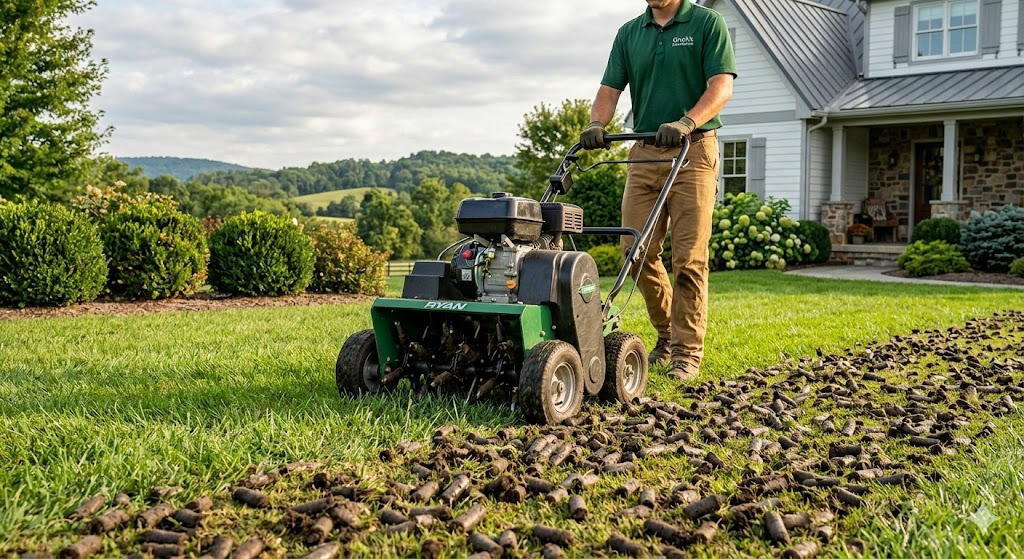
4. Core Aeration: Maximizing Lawn Care Treatments 🕳️
Because of the heavy clay in the tri-state area, your lawn literally “suffocates” over time. Traffic from pets, children, and even lawnmowers packs the soil particles together, pushing out the oxygen.
The Process: Core aeration uses a machine to pull 2-3 inch plugs of soil out of the ground. This allows:
- Oxygen to reach the root zone.
- Water to penetrate deeper into the soil rather than running off into the street.
- Lawn Care Treatments like fertilizer and lime to reach the roots directly. ☀️
5. Overseeding with High-Quality Turf-Type Tall Fescue 🌾
Lawns are living organisms that eventually grow old. To keep a lawn thick and weed-resistant, you must introduce new “young” genetics every year.
The Tri-State Gold Standard: We recommend Turf-Type Tall Fescue (TTTF) for most MD, PA, and WV homes. Unlike the “Kentucky 31” of the past, modern TTTF is dark green, fine-bladed, and incredibly drought-tolerant. When we perform these Lawn Care Treatments, we use seed blends specifically rated by the National Turfgrass Evaluation Program (NTEP) for our specific zone. 📈
6. Grub and Surface Insect Protection: Protective Lawn Care Treatments 🐛
White grubs are the larvae of Japanese Beetles and Masked Chafers. They live in the soil and eat grass roots during the late summer. If you have ever seen crows or skunks digging up your yard, they are looking for grubs.
Preventative vs. Curative: A curative treatment only kills what is there now. Our preventative Lawn Care Treatments protect the lawn for the entire season. We also monitor for surface feeders like Chinch bugs, which are common in the drier parts of Pennsylvania and can turn a lawn brown in a matter of days. 🔍
7. Lime Applications for pH Balancing ⚪
In the tri-state area, our soil is naturally acidic due to rainfall and organic matter breakdown. When soil pH drops below 6.0, the “chemistry” of the soil changes. Nutrients become “locked” and unavailable to the grass.
The Solution: Pelletized lime is one of the most cost-effective Lawn Care Treatments. It raises the pH, making your fertilizer 30% to 50% more effective. We recommend applying lime in the late fall or early winter so the freeze-thaw cycles can help it move into the root zone. 🧊
Tri-State Lawn Care Treatments Month-by-Month Calendar 🗓️
To help you plan, here is the standard schedule we follow at Grosh’s Lawn Service:
- March – April: Soil testing and the first round of Pre-emergent Lawn Care Treatments. This is the time to stop crabgrass before it starts.
- May – June: Broadleaf weed control for dandelions and clover, plus a balanced fertilizer to prepare for summer heat.
- July – August: Grub protection and monitoring for fungus (like Brown Patch or Dollar Spot) which thrives in tri-state humidity.
- September – October: The “Lawn Care Season Finale.” This is the window for Core Aeration, Overseeding, and heavy Fall Fertilization.
- November – December: Winterizer fertilizer and Lime applications to balance soil pH for the upcoming spring.

Why Professional Lawn Care Treatments Outperform DIY 👷♂️
While big-box stores sell “4-step programs,” they are designed for a general national average, not for the specific clay-heavy needs of Clear Spring, MD, or the limestone ridges of West Virginia.
The Professional Advantage:
- Commercial Grade Products: Our Lawn Care Treatments use professional-grade, slow-release fertilizers that you cannot buy at a retail store.
- Calibrated Equipment: We ensure every square inch of your lawn gets the exact amount of product needed—no more, no less.
- Local Expertise: We know the local weed species and pest cycles that affect the tri-state area. 🚜 Visit our Lawn Care Treatments page to learn more about our specific local programs.
Lawn Aeration – Core aeration is one of the most vital Lawn Care Treatments for maintaining a healthy, resilient yard in the tri-state area’s heavy clay soils. Over time, foot traffic, lawnmowers, and natural settling compress the soil particles, eliminating the tiny air pockets necessary for root respiration. This compaction acts as a physical barrier, preventing water, oxygen, and nutrients from reaching the root zone.
By removing small plugs of soil, aeration “opens up” the ground, allowing the lawn to breathe. This process triggers several critical biological benefits:
- Enhanced Root Growth: With less physical resistance, roots can grow deeper, making the grass more drought-tolerant during hot Maryland and West Virginia summers.
- Improved Drainage: Aeration breaks up surface crusting, ensuring rainwater and irrigation soak into the soil rather than running off into the street.
- Thatch Breakdown: Introducing oxygen into the soil stimulates the microbes that naturally decompose thatch, preventing it from choking out your turf.
For the best results, aeration should be paired with overseeding in the fall. This ensures that new grass seed makes direct contact with the soil inside the aeration holes, leading to a thicker, greener lawn that naturally resists weeds and pests. 🌿
Hashtags #️⃣
#LawnCareTreatments #GroshsLawnService #TriStateLawnCare #MarylandLawn #PennsylvaniaLawn #WestVirginiaLawn #LawnMaintenance #GreenGrass #SoilTesting #AerationAndOverseeding

Call to Action: 🌟 Ready to get your lawn on the right track? Contact Grosh’s Lawn Service today to schedule your lawn care treatment estimate! Let Tom and the team provide the expert care your tri-state yard needs for a lush, green finish. 🚀
An official production of Grosh’s Lawn Service.
All rights reserved.